
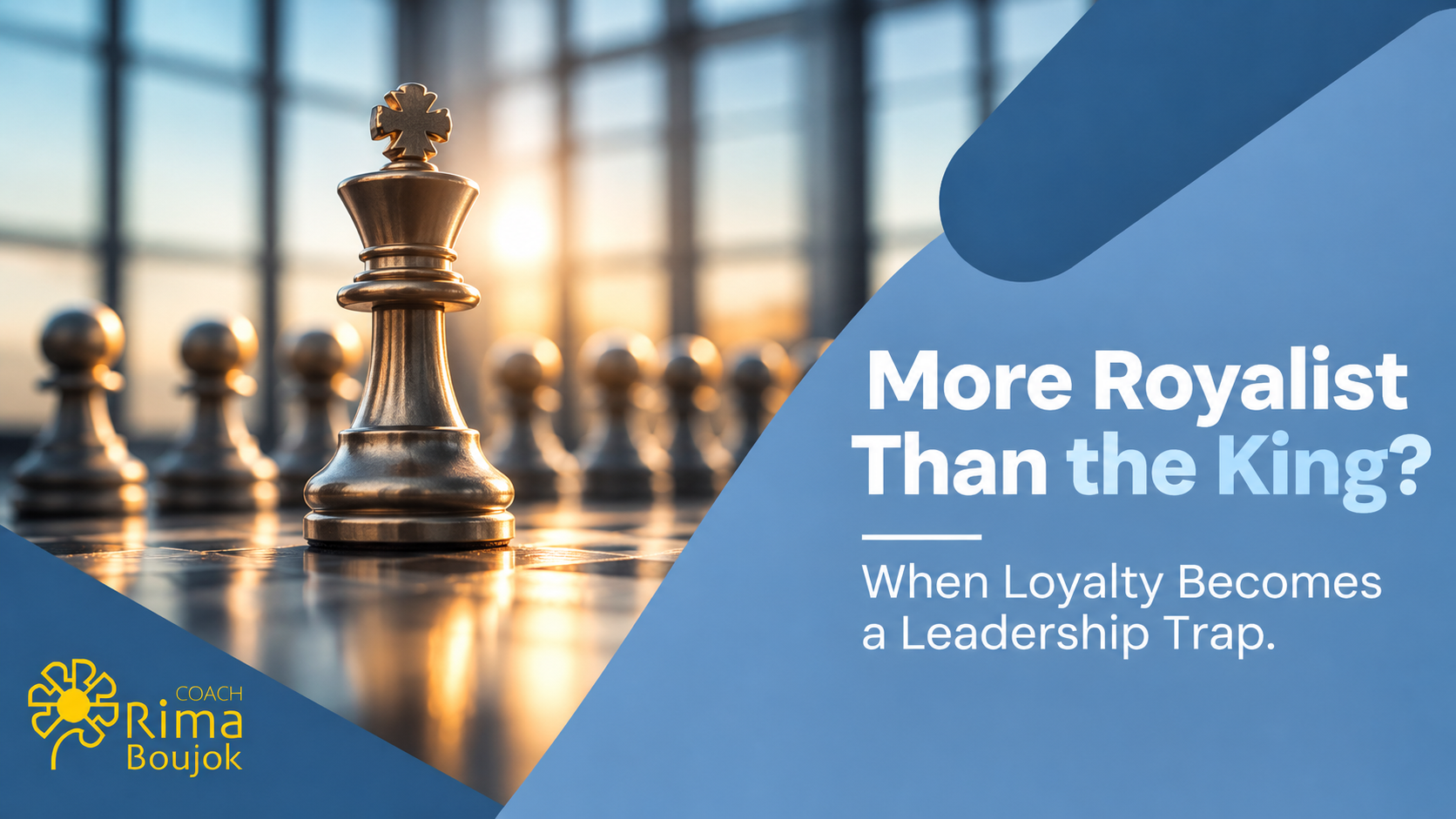
You cannot be more royalist than the king. But what happens when the king himself is no longer a royalist?
What happens when those who are supposed to embody an organization’s vision, values, and commitments are the first to compromise them?
And perhaps the more uncomfortable question: What happens when you remain more committed to someone else’s vision than they are themselves?
The Loyalty Paradox
Throughout my executive career, I have witnessed a fascinating, and sometimes painful, leadership paradox.
- Talented executives defending strategies their CEOs had already abandoned.
- Dedicated managers protecting organizational values that their leadership teams were no longer demonstrating.
- Committed employees sacrificing their well-being, relationships, and personal aspirations for organizations that had quietly changed their priorities.
Not because these individuals lacked judgment. But because they believed loyalty meant staying committed, regardless of the circumstances.
They confused perseverance with purpose. And commitment with obligation.
Yet loyalty, when disconnected from discernment, can become one of leadership’s most dangerous blind spots.
When Commitment Outlives Conviction
Imagine an executive who has spent years building a division, developing people, protecting resources, and championing a strategic direction.
One day, the CEO’s priorities change. The investment disappears. The strategy loses sponsorship. The values that once guided decisions become negotiable.
Yet the executive continues fighting. Defending the original vision. Convincing the team to remain committed. Absorbing the frustration, uncertainty, and emotional cost.
Until one day, a difficult realization emerges: I am fighting harder for this vision than the person who created it.
This is where leadership requires something more demanding than loyalty. It requires clarity.
Loyalty to Whom? Loyalty to What?
One of the most important distinctions I explore with executives is the difference between loyalty to a person, loyalty to an organization, and loyalty to a purpose.
These are not always aligned.
- Loyalty to a person can create trust, continuity, and strong relationships.
- Loyalty to an organization can inspire ownership and collective achievement.
- Loyalty to a purpose can provide direction when circumstances become uncertain.
But what happens when the person changes direction, the organization compromises its values, or the original purpose no longer exists? Should loyalty remain unconditional?
I believe leadership maturity is demonstrated not by how long we remain loyal, but by how consciously we choose what deserves our loyalty.
Loyalty is a value. Blind devotion is a vulnerability.
The Hidden Cost of Being More Royalist Than the King
When leaders continue defending commitments that are no longer supported from above, the consequences extend far beyond personal disappointment.
1. Strategic energy is wasted.
Time, resources, and attention are invested in priorities that no longer have genuine executive sponsorship.
2. Teams receive contradictory signals.
Employees hear messages about commitment, accountability, and values while observing decisions that communicate something entirely different.
3. Credibility begins to erode.
Leaders risk becoming the defenders of promises they no longer have the authority to fulfill.
4. Personal identity becomes tied with organizational loyalty.
Stepping away begins to feel like betrayal, even when staying means compromising one’s own principles.
And perhaps most dangerously, leaders begin measuring their worth by how much they are willing to endure. But endurance is not always leadership. Sometimes, it is simply the inability to recognize that the rules of the game have changed.
Leadership by Design: From Blind Devotion to Discernment
Leadership by Design invites us to replace automatic reactions with intentional choices.
When loyalty is tested, I encourage leaders to reflect on five questions:
1. What am I truly loyal to?
The individual, the title, the institution, the shared values, or the purpose we originally committed to?
2. Is this commitment still mutual?
Am I continuing to uphold expectations that the other party has already abandoned?
3. What is the cost of my loyalty?
To my credibility, my team, my energy, my principles, and my future?
4. Am I protecting a meaningful purpose or defending a past decision?
There is a profound difference between perseverance and attachment.
5. If I were making this decision today, with everything I now know, would I make the same commitment?
This last question is particularly powerful. It separates yesterday’s emotional investment from today’s strategic judgment.
The Courage to Redefine Loyalty
Leadership does not require us to abandon people when circumstances become difficult.
Quite the opposite.
It calls for courage, constructive challenge, difficult conversations, and the willingness to stand by our commitments when doing so is meaningful. But loyalty should never demand the abandonment of judgment.
A mature leader can support a CEO without agreeing with every decision. Can serve an organization without defending every practice. Can honor a shared history without becoming imprisoned by it. And can recognize when the most responsible act is no longer to defend the original direction, but to question whether it still deserves defending.
Because leadership is not about being the last person standing behind a decision everyone else has abandoned. It is about knowing when to stand firm, when to challenge, when to realign, and when to walk away.
A Final Reflection
Perhaps the real danger is not being more royalist than the king. Perhaps it is failing to notice that the king has changed kingdoms while we are still defending the old one. And this brings me to a question worth asking: Are you remaining loyal because the purpose still deserves your commitment, or because you have invested too much of yourself to reconsider it?
Leadership by Design is about making that distinction consciously. Because exceptional leadership is not measured by unconditional devotion. It is measured by the courage to remain loyal to your values, even when that requires questioning the very people you once followed.
Rima Boujok | Leadership Architect | Executive & Business Coach | Thinking Partner